
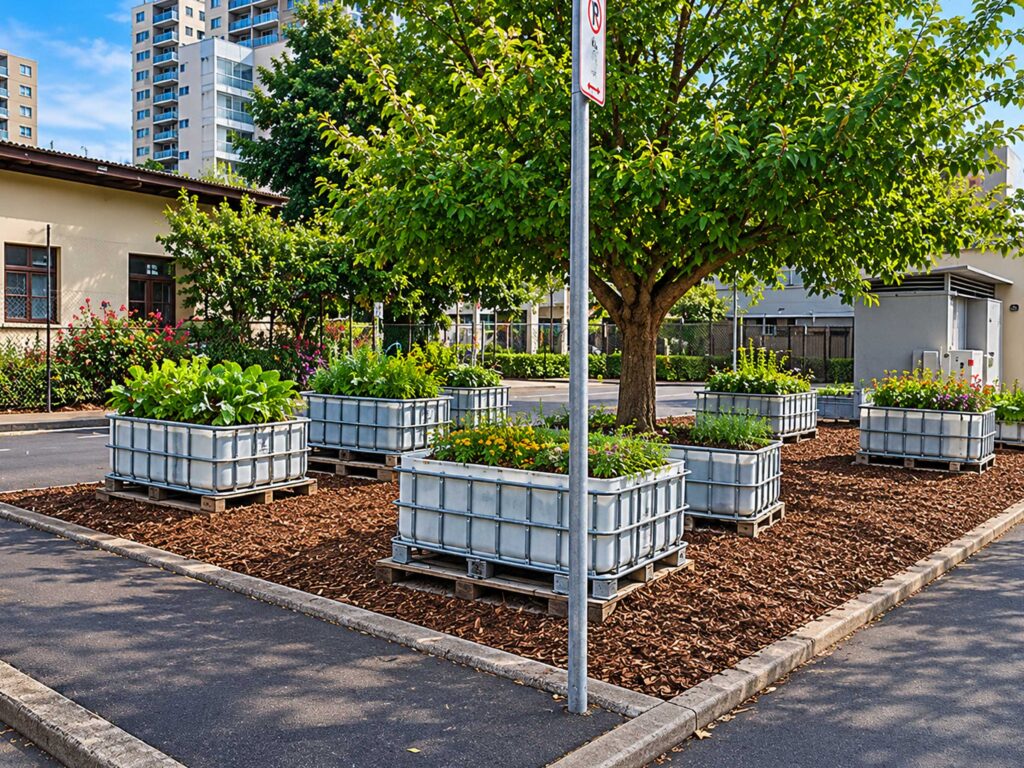
Directly across the road from the grand neoclassical facade of the Fitzroy Town Hall, an unexpected patch of green thrives in the centre of Condell Street. Rather than manicured turf or ornamental street trees, the wide median strip holds thirty-six timber planter boxes overflowing with silverbeet, culinary herbs, heirloom tomatoes, and indigenous Australian flora. Operated by the volunteer-led group Condell Growers and Sharers, this unfenced pocket of urban agriculture demonstrates how inner-city residents without backyards can cultivate fresh food, build soil health, and connect with their neighbours.
Reimagining Inner-City Space on Wurundjeri Woi-wurrung Land
Fitzroy is defined by its dense Victorian terraces, converted warehouses, and multi-storey apartment buildings. For many locals, private outdoor space is limited to a narrow balcony, a paved courtyard, or a sunny windowsill. Occupying public land supported by the City of Yarra, Condell Growers and Sharers solves the spatial constraints of inner-Melbourne living by turning an underutilised road median into a shared productive landscape.
Unlike traditional fenced allotments that restrict access to plot holders, the Condell Street garden sits completely open to the streetscape. Pedestrians walking between Brunswick Street and Nicholson Street pass directly alongside the beds, watching seasonal crops change throughout the year. The layout relies on raised planter boxes and water-efficient wicking beds, a practical design choice that keeps soil elevated above road runoff while minimising water loss during Melbourne’s warm summers.
Practical Lessons in Small-Space Sustainable Living
For apartment dwellers and courtyard gardeners looking to improve their own home setups, the median strip serves as a living demonstration of small-scale horticulture. Raised timber beds allow gardeners to control soil quality completely, bypassing the heavy clay or compacted ground common across older inner-northern suburbs. By layering rich organic compost, coarse mulch, and seasonal companion plantings, volunteers maintain vigorous yields within a compact footprint.
Beyond food production, the garden integrates native biodiversity into the urban streetscape. Shared beds feature indigenous plants and traditional bushfoods alongside pollinator-attracting flowers, supported by educational signage acknowledging Fitzroy’s deep significance to Victoria’s Aboriginal community. A First Nations mural further anchors the site, reminding visitors that caring for Country and cultivating local food remain deeply linked even in a dense metropolitan setting.
Closing the Loop Through Neighbourhood Composting
One of the most impactful everyday initiatives at Condell Growers and Sharers happens behind the scenes at its dedicated composting station. Food scraps sent to landfill generate methane, yet high-density living often leaves residents without the space for a backyard compost heap or worm farm. Through a structured community composting program, participating locals divert household organic waste away from municipal bins and transform it into nutrient-dense humus.
This closed-loop system directly feeds the thirty-six planter boxes, reducing reliance on commercial fertilisers while improving moisture retention in the soil. For households keen to adopt similar habits at home, the garden’s approach highlights the importance of balancing nitrogen-rich kitchen scraps with carbon-rich dry leaves, shredded cardboard, and woody prunings to keep aerobic decomposition odour-free in compact spaces.
A Living Room on the Street
Urban gardens rarely succeed on horticultural technique alone; they endure because they create a welcoming social rhythm. Regular monthly working bees bring plot holders, compost contributors, and curious passers-by together to prune, mulch, turn compost bays, and swap surplus seedlings. Experienced growers share practical advice on managing seasonal pests without synthetic chemicals, while newcomers learn how to propagate herbs or prepare beds for cool-weather brassicas.
In a suburb celebrated for its independent bookshops, galleries, and cafés, Condell Growers and Sharers offers a quieter, grounded form of daily enrichment. By transforming a strip of asphalt-flanked median into an open-air classroom and productive larder, the garden proves that sustainable living in Fitzroy does not require acreage, only shared stewardship and a willingness to get a little soil under the fingernails.