
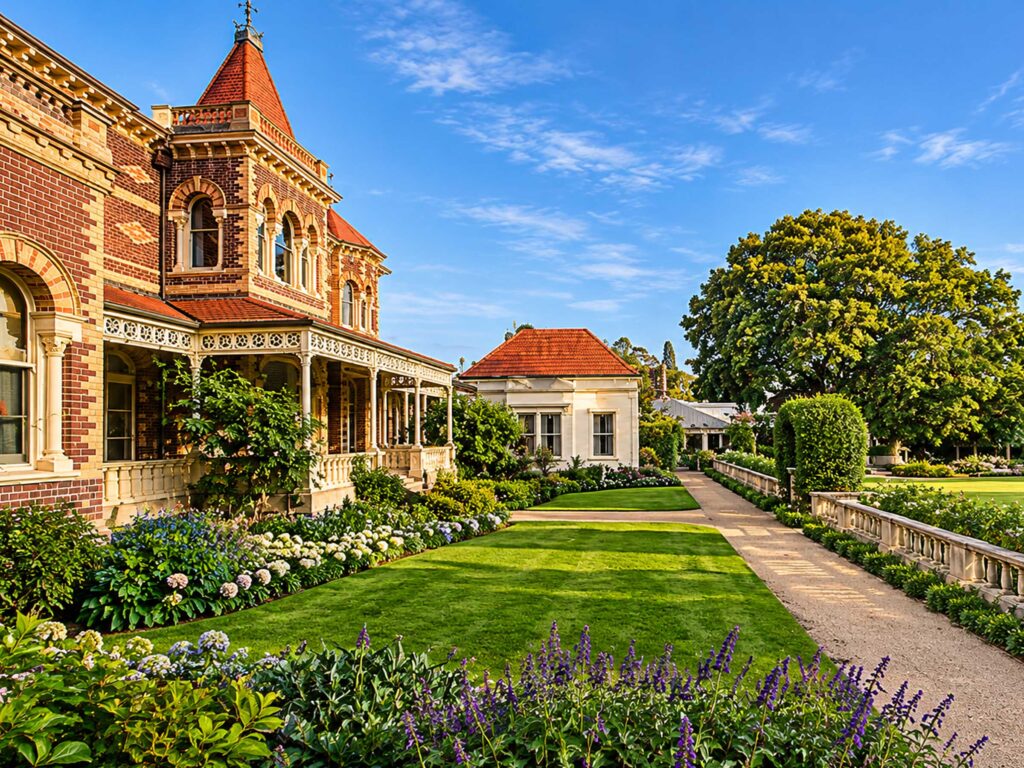
Tucked behind high brick walls off Hotham Street, the polychrome brickwork, slate towers and sprawling pleasure gardens of Rippon Lea Estate stand as Elsternwick’s most recognisable historical landmark. Yet long before the property entered public care as a protected heritage site, it was first and foremost a lively family home shaped by the ambition, domestic devotion and civic spirit of two remarkable nineteenth-century Melburnians: Frederick Thomas Sargood and his wife, Marion Australia Rolfe.
Arriving in Victoria as a teenage migrant during the early gold rush years, Frederick Sargood rose through Melbourne’s mercantile and parliamentary ranks while building a semi-rural sanctuary in Elsternwick where he and Marion raised their large family. Their personal journey traces how an ambitious young newcomer helped transform a quiet pocket of market gardens and paddocks into an enduring cultural cornerstone of Melbourne’s inner south-east.
An Immigrant Family’s Rise in Colonial Melbourne
Born in London in 1834, Frederick Thomas Sargood emigrated to Victoria in 1850 alongside his parents, arriving just as the colony stood on the threshold of the gold rush boom. Entering his father’s softgoods importing business, Sargood demonstrated an early aptitude for commerce, logistics and organisational discipline. Within a decade, he had risen to become a partner in what grew into one of Australasia’s largest wholesale drapery enterprises.
In 1858, Sargood married Marion Australia Rolfe, the daughter of fellow Melbourne merchant and politician George Rolfe. Over the course of their marriage, the couple welcomed eleven children, ten of whom survived into adulthood. As their household expanded and Melbourne’s inner suburbs grew increasingly crowded, the couple sought land beyond the city centre where their children could enjoy fresh air, open space and room to roam.
Building a Home Named for Family
In 1868, the couple purchased roughly 17 hectares of land in Elsternwick and commissioned architect Joseph Reed to design a substantial residence. They named the estate Rippon Lea in honour of Frederick Sargood’s mother, Emma Rippon, grounding their new home in family memory from its very foundation.
Over the ensuing decades, the house evolved alongside the family’s changing needs. Originally constructed as a fifteen-room Italianate mansion, the residence was progressively enlarged into a grand Romanesque-influenced home featuring a striking lookout tower, shaded verandahs and generous reception rooms. Inside, domestic life balanced Victorian formality with genuine family warmth. Gardens were laid out not simply for display, but for children’s games, boating on the ornamental lake, archery on the lawns and riding along tree-lined paths.
Ingenious Solutions for a Growing Estate
Maintaining lush orchards, glasshouses, a fernery and sweeping lawns in a suburb that then lacked reliable reticulated water posed a formidable practical challenge. Rather than accepting seasonal drought, Sargood applied his talent for problem-solving to devise a sophisticated water-harvesting network across the property.
Through underground drains, brick storage tanks, windmills and elevated reservoirs, rainwater captured from rooftops and surrounding paddocks was collected and distributed throughout the gardens and lake. That self-sufficient engineering allowed the estate to flourish through dry Melbourne summers, establishing horticultural features that still astonish visitors more than a century later.
Public Service and Community Life in Elsternwick
For Frederick and Marion Sargood, private success carried an obligation to serve the wider community. Entering the Victorian Legislative Council in 1874, Sir Frederick Sargood, knighted in 1890 for his public contributions, went on to serve as Victoria’s first Minister of Defence, Minister of Public Instruction and later as an inaugural senator in the first Australian Federal Parliament in 1901.
Closer to home in Elsternwick, the couple opened their gates generously for community gatherings, charity fetes, school excursions and musical recitals. Both were active supporters of local institutions, charitable hospitals and educational initiatives, while Marion managed an extensive household staff with a reputation for fairness and quiet philanthropy. Tragically, Marion Sargood died in 1889 after more than thirty years of marriage, leaving a profound void in both her family and the local civic circle she had helped nurture.
A Legacy Preserved for Generations
Following Sir Frederick Sargood’s death in 1903 while travelling in New Zealand, Rippon Lea passed through subsequent custodians, notably the Nicholas family, who preserved the estate’s character before transferring it to the National Trust of Australia (Victoria) in 1974. Through every transition, the human imprint left by its original builders remained unmistakable.
Today, when Elsternwick residents walk beneath the mature trees, admire the nineteenth-century fernery or gather on the lawns where the Sargood children once played, they are stepping inside the lived legacy of a family that believed in building things meant to endure. By uniting enterprise, ingenuity and generosity of spirit, Frederick and Marion Sargood left behind far more than a historic house; they gifted Elsternwick a lasting sense of place.