
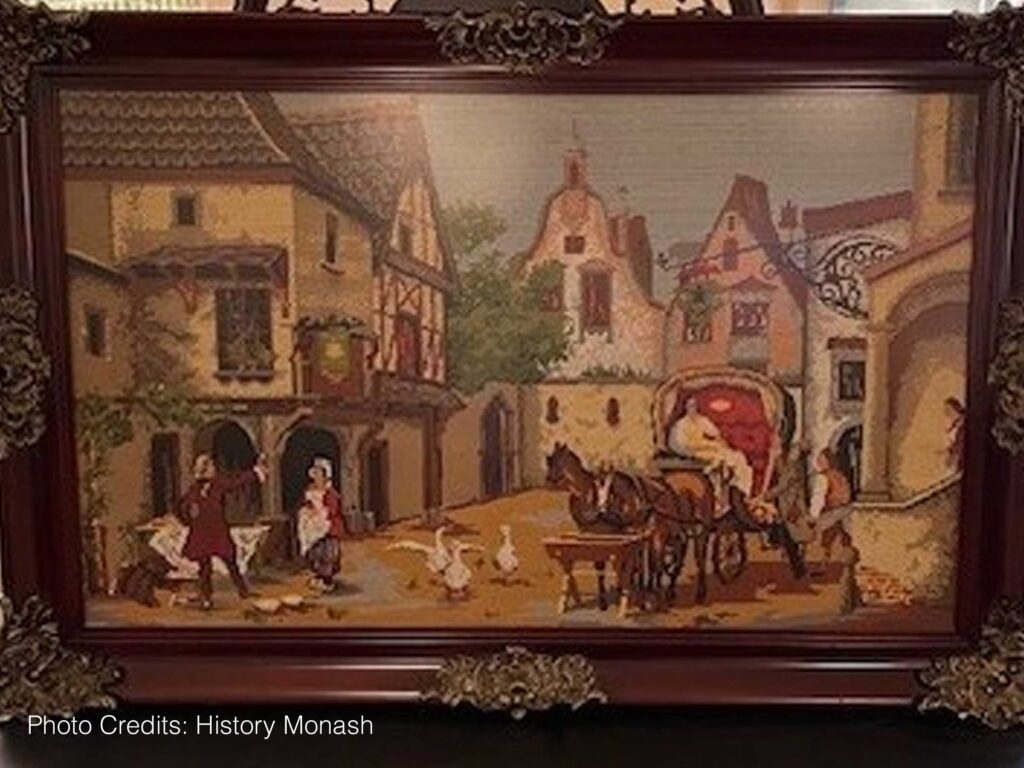
Preserved within the archives of History Monash Inc at the Monash Federation Centre on Atherton Road in Oakleigh hangs a framed hand-stitched tapestry measuring 134 centimetres by 90 centimetres. Entitled Le bienvenu, or “the welcome”, the richly detailed textile work was completed in Melbourne in 1988 by Olga Kouroupis. Behind its thousands of neatly counted stitches lies a remarkable story of post-war migration, relentless work ethic and the quiet determination to keep creative craft alive amidst demanding everyday responsibilities.
Suburban history is often recorded through civic buildings, commercial directories and official milestones, yet some of the most revealing records of community life reside inside domestic objects made by ordinary residents. In Oakleigh and its surrounding south-eastern suburbs, where post-war European migration reshaped entire neighbourhoods, handmade textiles carried from overseas or stitched in Melbourne living rooms stand as tangible links between old worlds and new beginnings.
From a Northern Greek Village to Melbourne’s South-East
Born and raised in Toumba, a village in northern Greece, Olga Kouroupis taught herself to stitch tapestries and doilies as a child. Even in her youth, the quality of her needlework was recognised locally, earning her small sums of money for finished pieces and establishing a lifelong devotion to textile handcraft.
In 1967, at the age of twenty-four, she migrated to Australia alongside her husband and their two young children, aged two and four. Travelling aboard the migrant vessel Patris, the young family arrived in Melbourne and settled in nearby Clayton, part of the wider south-eastern industrial and residential corridor anchored by Oakleigh’s shops, community networks and cultural institutions. Like tens of thousands of families arriving during that era, they began building a new life from the ground up in an unfamiliar country.
Finding Creative Focus Amidst Factory Shifts and Family Life
Life for newly arrived migrant families in Melbourne’s south-east demanded extraordinary stamina. While working full time in a factory and managing a busy household with three children alongside boarders living in the home, Olga Kouroupis refused to let her creative practice disappear. Rather than waiting for rare stretches of uninterrupted leisure, she wove her stitching directly into the margins of her working day.
She regularly carried her tapestry canvas to the factory, using her midday break to stitch instead of stopping to eat lunch. Working with double threads and enlarging the pattern manually by studying a paper reference image and counting individual squares, she combined remarkable speed with disciplined precision. Even with her practiced hand, a work of such scale required many weeks of sustained concentration across lunch breaks and late evenings.
Craft as Continuity and Cultural Memory
For many post-war migrant women across Victoria, needlework, crochet and tapestry served as far more than decorative pastimes. Practised in moments carved out between shift work and domestic duties, handcraft offered a familiar anchor of identity, calm and personal agency during years of rapid adjustment. Creating an artwork titled Le bienvenu in a home that regularly welcomed boarders and extended family carried an unmistakable resonance.
Today, the preservation of the tapestry within History Monash Inc ensures that individual stories of migrant women’s labour and artistry remain visible alongside broader civic histories of Oakleigh and district. Operating from 3 Atherton Road on the lands of the Boon Wurrung and Woi Wurrung language groups of the Eastern Kulin Nation, the volunteer-run society safeguards photographs, documents and personal artefacts that illuminate how everyday residents shaped the region.
The Quiet Artistry Behind Suburban Heritage
Standing before a hand-counted tapestry of 134 centimetres by 90 centimetres invites reflection on the hours of patience compressed into every square inch of thread. When viewed alongside the story of how it was made, the work becomes a portrait of quiet resilience. Through her needlework, Olga Kouroupis left behind not only a finely crafted textile, but a lasting reminder of the creativity, generosity and perseverance that helped define post-war life in Oakleigh and Melbourne’s south-east.