
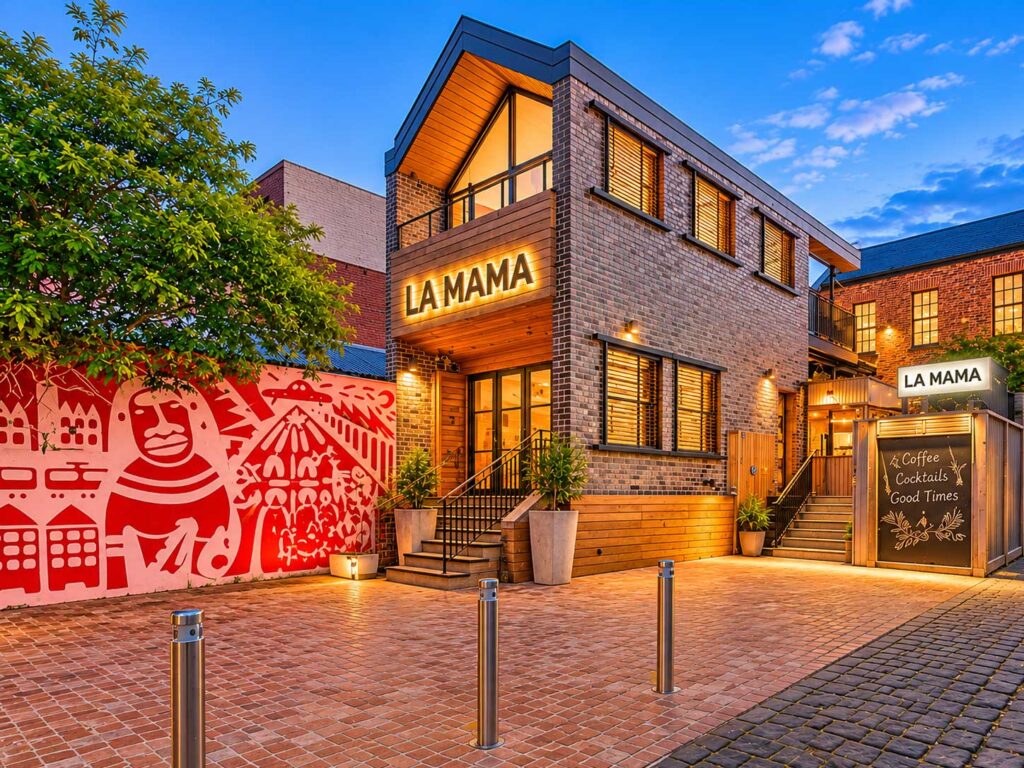
Tucked behind a weathered brick facade on Faraday Street in Carlton, a small courtyard leads into one of Australia’s most influential cultural rooms. For half a century, that intimate space was guided by Liz Jones AO, a theatre director, performer and arts administrator whose quiet determination helped transform a 50-seat former printer’s workshop into an indispensable incubator for Australian storytelling.
While Carlton has long been celebrated for its Italian coffee culture, heritage terrace rows and proximity to the University of Melbourne, its reputation as a cradle of contemporary Australian arts owes an extraordinary debt to the people who kept its independent stages alive. At the centre of that story stands Liz Jones, whose 50-year stewardship of La Mama Theatre shaped generations of playwrights, actors and local audiences.
From Academic Corridors to a Backyard Stage
Born in 1946, Liz Jones graduated from the Australian National University in 1965 with a Bachelor of Arts before finding her way into Melbourne’s burgeoning countercultural arts scene. In the late 1960s and early 1970s, Carlton was an affordable, bohemian enclave populated by students, activists, writers and migrant families. Local stages across Australia were still heavily dominated by British theatrical traditions, leaving little room for authentic Australian voices or experimental forms.
When educator and arts visionary Betty Burstall founded La Mama at 205 Faraday Street in 1967—inspired by the off-off-Broadway café theatres she had encountered in New York—she set out to create a room where new ideas could be tested without commercial pressure. Liz Jones joined the company in 1973 as a performer and administrator, immersing herself in its rough-and-ready ethos. Three years later, in 1976, she stepped into the role of artistic director, beginning a tenure that would span nearly five decades.
Championing Risk Over Commercial Formula
Under the leadership of Liz Jones, La Mama remained fiercely committed to a rare philosophy: programming work based on artistic curiosity rather than box-office predictability. In an era when emerging writers often struggled to have Australian vernacular and lived experiences taken seriously, Faraday Street became an open door.
The physical space itself reinforced that intimacy. Audiences gathered in a small courtyard around an open fire on crisp Melbourne evenings before climbing a steep wooden staircase or stepping into a room with a working sink, an open fireplace and barely 50 seats. There was no barrier between performer and spectator. Over the decades, the venue nurtured early works by figures who would become household names across Australian stage and screen—including playwrights David Williamson and Jack Hibberd, writer Helen Garner, Uncle Jack Charles, Cate Blanchett and Judith Lucy—while giving equal care to first-time theatre-makers staging experimental poetry, First Nations storytelling and political cabaret.
Rather than treating the theatre as an isolated institution, Liz Jones embedded it into the daily rhythms of Carlton. Posters were pasted across neighbourhood cafés and bookshops, audiences lingered after performances over tea and conversation with the cast, and longstanding ties with the property’s owners, the Del Monaco family, eventually enabled the company to purchase 205 Faraday Street outright in 2007–2008 following a major community fundraising effort.
Rebuilding From the Ashes on Faraday Street
That deep bond between the theatre and its neighbourhood was tested in the early hours of Saturday, 19 May 2018, when an electrical fault sparked a devastating fire that tore through the 135-year-old Faraday Street building. Within forty minutes, the roof had collapsed and the interior was gutted, leaving little more than the outer brick shell standing.
For Liz Jones, then in her seventies, the loss was deeply personal. Yet within hours of inspecting the charred remains, she stood before artists, neighbours and supporters with an unmistakable resolve to rebuild. Working alongside co-CEO Caitlin Dullard and the wider arts community, she helped spearhead a campaign that raised more than $3 million through government support, philanthropic trusts and thousands of individual donations from theatre lovers across Melbourne and beyond.
While construction was underway, programming continued across the road at the neighbouring La Mama Courthouse on Drummond Street and at local community spaces. When the rebuilt Faraday Street venue reopened in late 2021, it honoured the quirks and intimacy of the original building while introducing full physical accessibility, improved rehearsal areas and updated infrastructure for future generations of artists.
A Lasting Imprint on Melbourne’s Cultural Landscape
Throughout her career, the contributions of Liz Jones earned national recognition, including appointment as an Officer of the Order of Australia (AO), an honorary doctorate from the Australian National University, the Australia Council Award for Theatre in 2018 and the Sue Nattrass Award for lifetime achievement at the 2019 Helpmann Awards. Yet those who worked beside her consistently pointed not to formal honours, but to her daily presence—greeting patrons at the gate, encouraging nervous first-time directors and defending space for bold, unpolished ideas.
When Liz Jones stepped down as artistic director in early 2023, exactly fifty years after first walking through the doors in 1973, she left behind far more than a restored brick building. Her decades on Faraday Street demonstrated how a single neighbourhood venue, tended with patience and generosity, can reshape an entire nation’s cultural conversation while remaining anchored to the community outside its front gate.