
Long before Brighton became synonymous with its colourful bathing boxes and busy coastal promenades, the suburb’s quiet tree-lined estates nurtured a remarkable circle of pioneering Australian women artists. At the heart of that story stands Janet Cumbrae Stewart, a Brighton-born painter and pastellist whose quiet determination carried her from childhood sketching trips along Port Phillip Bay to the prestigious salons of London and Paris.
Born on 23 December 1883 at Montrose, a sprawling twenty-room residence set amid seven acres of gardens on the corner of Were Street and Cairnes Crescent in Brighton, Janet Agnes Stewart was the youngest of ten children. While her brothers attended leading boys’ schools, Janet was educated largely at home by a governess, spending three terms at Manor House where she formed a lasting friendship with fellow aspiring painter Norah Gurdon. Even as a toddler, her artistic instincts were unmistakable; family accounts recall her dipping a finger into milk and bread to sketch cows on the tablecloth at age three, and later rubbing out pencilled entries in her father’s old cash books to make room for drawings.
Breaking Away From Convention in Brighton
Pursuing art as a serious profession was far from an expected path for a young woman of her social standing in late Victorian Melbourne. Her father, Francis Edward Stewart, a prominent banking and wool-broking executive, initially resisted the idea of formal art training. Yet encouragement came from landscape painter John Mather, who took the young artist on outdoor sketching excursions around the Bayside coast.
In 1901, Cumbrae Stewart enrolled at the National Gallery of Victoria Art School, studying under Lindsay Bernard Hall and Frederick McCubbin until 1907. There, she formed a lifelong creative sisterhood with fellow Brighton residents Jessie Traill and Norah Gurdon. Her technical command quickly set her apart, earning her multiple student prizes for antique drawing, still life and life drawing, alongside second place in the 1905 National Gallery travelling scholarship competition.
Around this period, she also made a deliberate decision about her artistic identity. Following her eldest brother, who had added Cumbrae to the family surname in 1889, she adopted the name Cumbrae Stewart without a hyphen, signing her works simply with her surname. By omitting her first name and initials, she ensured critics, buyers and exhibition juries would judge her paintings entirely on artistic merit rather than gender.
Mastering Pastel and Earning International Acclaim
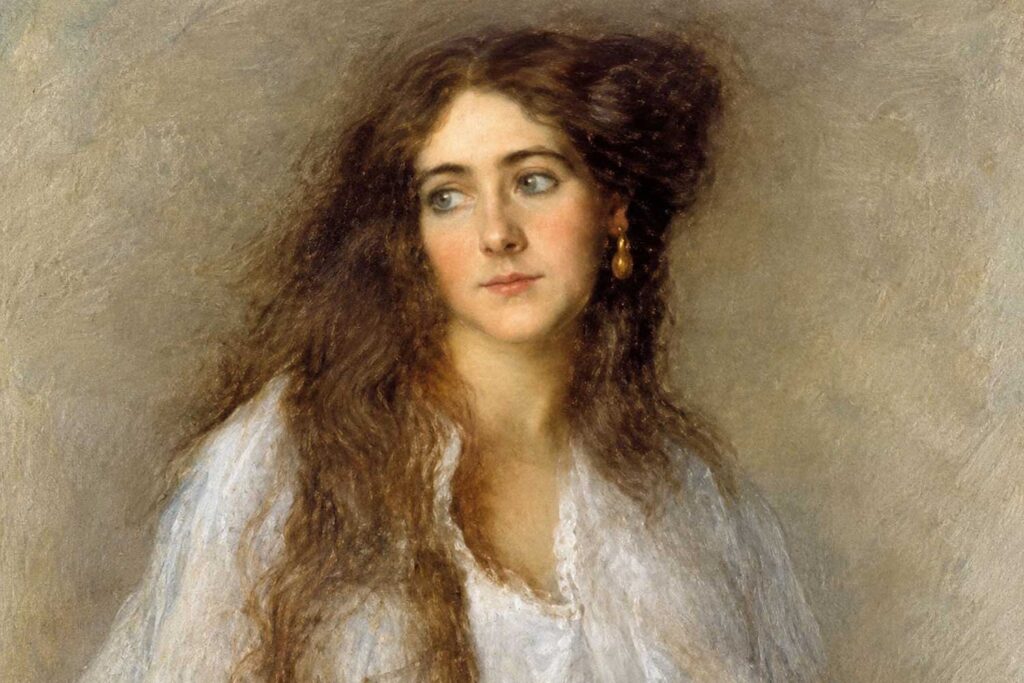
After leaving art school, Cumbrae Stewart rented a studio in central Melbourne and began exhibiting widely, including in the landmark 1907 First Australian Exhibition of Women’s Work and with the Victorian Artists Society. Her first solo show at Coles Book Arcade on Collins Street in 1911 drew immediate praise from peers, with both Bernard Hall and Rupert Bunny purchasing works from the exhibition. Although accomplished in oils and watercolours, she found her signature voice in pastel, bringing luminous colour, refined draughtsmanship and psychological warmth to portraits and studies of the female figure.
In 1922, seeking wider artistic horizons, she travelled to London with her sister Beatrice. Success followed swiftly. At her debut London exhibition, Queen Mary acquired two works, reportedly remarking that English artists would need to look to their laurels if Australians were producing work of such calibre. Over the next seventeen years, Cumbrae Stewart lived and painted across Britain, France and Italy—spending productive periods in Avignon, Caen and on the Italian Riviera at Laigueglia with her longtime companion, Argemore Bellairs.
Her international credentials expanded steadily during the 1920s and 1930s. She exhibited at the Royal Academy in London, held regular solo shows at the Galérie Beaux-Arts in Paris, and received an honourable mention at the Salon de la Société des Artistes Français in 1923. Across Australian newspapers, regular dispatches followed the triumphs of Brighton’s expatriate pastellist as she held her own in Europe’s most competitive art capitals.
A Lasting Imprint on Bayside’s Cultural Story
When Cumbrae Stewart returned to Australia in 1939 to visit family, the outbreak of the Second World War prevented her from returning to Europe. She settled permanently back in Melbourne, continuing to paint portraits, landscapes and commissioned works until shortly before her death in September 1960.
Though the grand twenty-room Montrose estate on Were Street was eventually subdivided and demolished, the family’s presence remains woven into the local streetscape through nearby Stewart Street. More importantly, her legacy continues to resonate through the Bayside Gallery and local historical collections, which regularly celebrate the generation of Brighton women who reshaped Australian art.
Looking back across more than a century, Janet Cumbrae Stewart‘s life offers an enduring portrait of quiet conviction. From sketching beneath the trees of Were Street to earning recognition on the walls of Paris, she carved out an independent creative life on her own terms, leaving behind a body of work that still glows with clarity, poise and human empathy.