
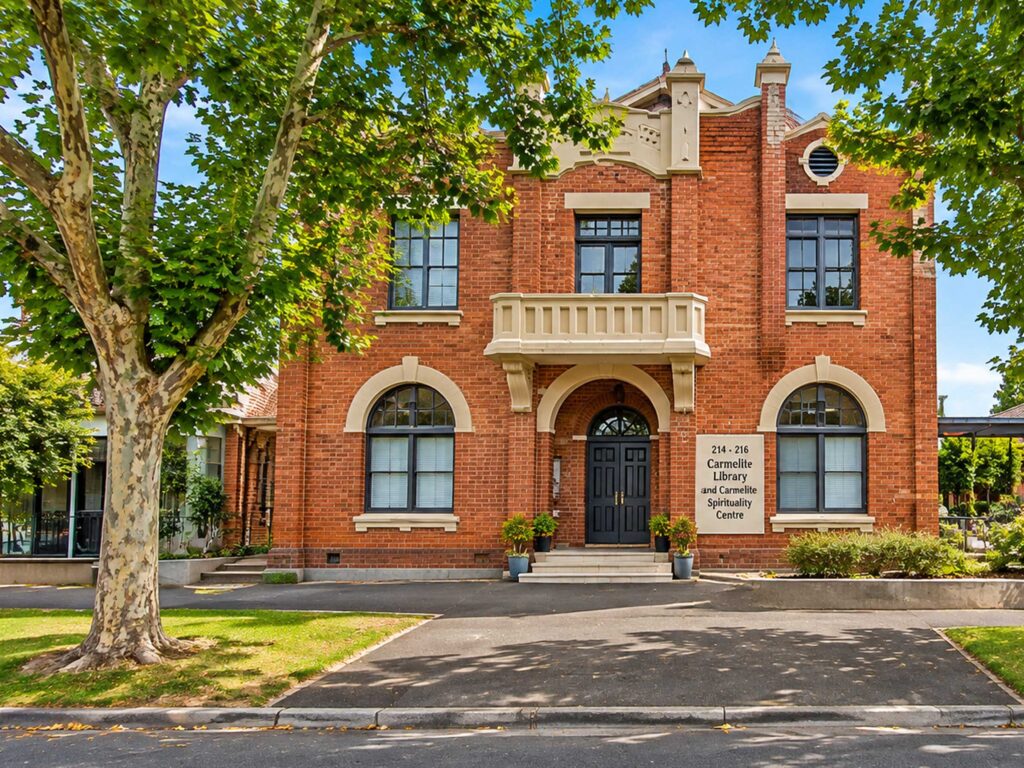
Along the leafy residential stretch of Richardson Street, just a short walk from the village bustle of Armstrong Street, the Gothic red-and-buff brick facade of the Carmelite Church rises above Middle Park’s Victorian terraces. Tucked beside the church inside the historic Carmelite Hall sits one of inner Melbourne’s most unexpected cultural sanctuaries: the Carmelite Library, a specialist collection dedicated to spirituality, theology, philosophy, and history that quietly welcomes both visiting scholars and curious local readers.
In a bayside suburb better known for coastal walks and sunlit cafes, the library represents a slower, contemplative dimension of community life. Behind its timber doors, rows of carefully catalogued volumes, sunlit reading tables, and unhurried guidance from specialist staff create a space where deep reading and human connection endure.
A Cultural Anchor Woven into Richardson Street
The story of the library is inseparable from the nineteenth-century arrival of the Carmelite order in the district. Constructed in 1891, the church complex on Richardson Street quickly became a focal point for parish life, education, and community gathering as Middle Park grew rapidly following the 1880s land boom.
Over decades, books gathered by Carmelite friars, educators, and theologians expanded from a private religious collection into a structured research library housed within the adjacent hall. Rather than keeping those shelves behind closed doors, the community opened the collection to the wider public, transforming an ecclesiastical archive into a civic asset for Melbourne readers.
Preserving Rare Texts and Living Scholarship
Today, the collection holds tens of thousands of print volumes alongside specialist periodicals, rare historical editions, and archival materials spanning centuries of contemplative thought and social history. Researchers exploring religious history, ethics, art, and literature travel from across Victoria to consult works rarely found in standard municipal branches.
Yet the atmosphere inside avoids any sense of institutional intimidation. High ceilings, natural light filtering through heritage windows, and the quiet rustle of turned pages give the reading room the warmth of a traditional study, inviting visitors to linger over a single text without the distractions of modern urban life.
The Stewards Who Keep the Doors Open
What truly defines the Carmelite Library as a neighbourhood institution is the human care behind its operation. Maintained by professional librarians working alongside dedicated volunteers, the facility operates on a ethos of personal hospitality and intellectual generosity.
Whether assisting a postgraduate student tracking down an obscure nineteenth-century commentary or helping a local resident find an introductory book on mindfulness or history, staff members take time to understand each visitor’s curiosity. Public lectures, book discussions, and small cultural gatherings hosted throughout the year further bridge the gap between specialist scholarship and everyday suburban life.
A Counterpoint to the Pace of Modern City Living
Within a compact suburb bordered by Port Phillip Bay and Albert Park Lake, spaces dedicated purely to quiet reflection are increasingly rare. While foreshore trails and village cafes nurture physical wellbeing and social energy, the reading room on Richardson Street offers a complementary refuge for intellectual stillness.
Generations of Middle Park residents have walked past the red-brick walls on their way to neighbouring Middle Park Primary School or down toward the beach, often unaware of the depth of scholarship preserved just inside. For those who step across the threshold, the library reveals another facet of the suburb’s character: a community that values stewardship, learning, and the quiet preservation of ideas.
Enduring Value in a Bayside Neighbourhood
More than a century after the first bricks were laid on Richardson Street, the Carmelite Library continues to thrive by remaining faithful to its core purpose. Through the dedication of its librarians, volunteers, and readers, this unassuming Middle Park institution proves that great cultural spaces do not require grand monuments, only open doors, good books, and people willing to share them.