
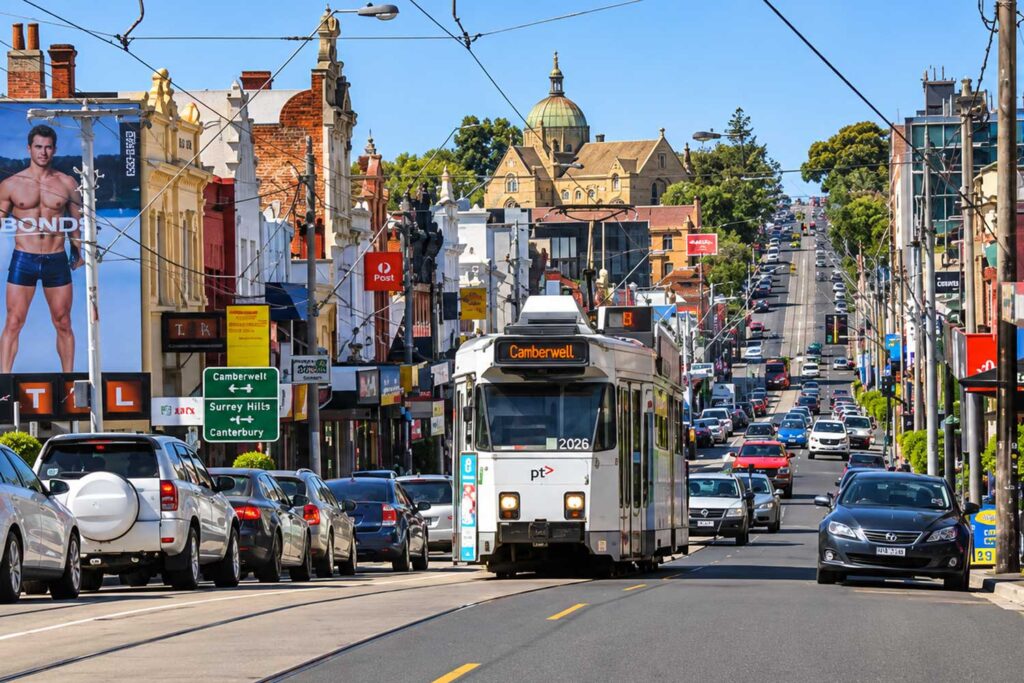
Ten kilometres east of Melbourne’s central grid, the physical character of Camberwell tells a story of deliberate continuity. Wide, tree-lined boulevards lined with Federation villas, Edwardian red-brick cottages and interwar California bungalows sit within a short walk of a bustling commercial junction, creating a suburb that feels simultaneously established and alive to modern urban rhythms. Looking at the bigger picture of Camberwell reveals a community shaped not by any single landmark, but by generations of civic planning, architectural stewardship and shared public spaces.
Long before suburban train lines and tram corridors connected the inner east to the city, the rolling hills of the district formed part of the traditional Country of the Wurundjeri Woi-wurrung people, who cared for the waterways and grassy woodlands bordering Gardiners Creek. European settlement in the mid-nineteenth century followed major coaching routes toward Gippsland, taking its name from the historic Camberwell Inn established at the crossroads of Burke, Camberwell and Riversdale roads in 1853.
From Rural Crossroads to Railway Suburb
The arrival of the railway from Melbourne in 1882 fundamentally transformed the district’s trajectory. Within a decade, land subdivisions radiated outward from the station, attracting merchants, tradespeople and families drawn by elevated topography, fresh air and direct rail access. Many of the ornate Victorian terraces and red-brick residences erected during the 1880s land boom still define the residential pockets surrounding Burke Road and Prospect Hill Road today.
By the early twentieth century, Camberwell had matured from a semi-rural village into a self-governing municipality, officially proclaimed a city in 1914. That civic confidence found lasting physical expression in the 1930s with the construction of the Camberwell Civic Centre and town hall complex on Camberwell Road. Designed in a restrained Georgian Revival style with distinctive brickwork and a prominent clock tower, the precinct became both an administrative anchor and a focal point for concerts, citizenship ceremonies and public gatherings.
Architectural Stewardship and Neighbourhood Character
One of the defining features of contemporary Camberwell is how deliberately its built environment has been protected amid Melbourne’s broader suburban densification. Across extensive residential precincts, heritage overlays administered through the City of Boroondara safeguard intact streetscapes of slate roofs, tuck-pointed brickwork, timber fretwork and mature front gardens.
This commitment to conservation extends beyond private homes to the public institutions woven through the suburb. State and independent schools established in the late nineteenth and early twentieth centuries, neighbourhood libraries, heritage churches and preserved cinema facades such as the 1940 Streamline Moderne Rivoli Cinemas anchor daily routines in familiar architectural surroundings. Even as contemporary apartment developments rise around the immediate transport interchange, surrounding residential streets retain a human scale that encourages walking and casual neighbourly connection.
Green Corridors and Shared Civic Life
Equally central to Camberwell’s social fabric is its network of public parklands and recreational reserves. Spaces such as Camberwell Sports Ground, Frog Hollow Reserve, Read Gardens and the linear parklands following Gardiners Creek provide essential breathing room for sporting clubs, dog walkers, weekend picnics and multi-generational family gatherings.
These shared spaces operate as the informal living rooms of the suburb. On any given weekend, junior cricket and football matches unfold beside morning walkers, community gardens and volunteer-led environmental care groups working to restore indigenous flora along local creek corridors. Rather than existing as isolated enclaves, residential streets connect naturally into these green arteries and civic hubs.
Continuity in a Changing Melbourne
As Melbourne continues to grow outward and upward, suburbs like Camberwell illustrate how long-term community identity relies on balance. Protecting architectural heritage without freezing a suburb in amber requires thoughtful urban planning, active civic institutions and residents who value stewardship over short-term turnover.
Viewed as a whole, Camberwell’s enduring appeal lies in that equilibrium. From its Wurundjeri foundations and nineteenth-century crossroads origins to its interwar civic halls, leafy reserves and vibrant neighbourhood centres, the suburb demonstrates how history, built form and collective civic pride work together to sustain a deeply connected Melbourne community.