
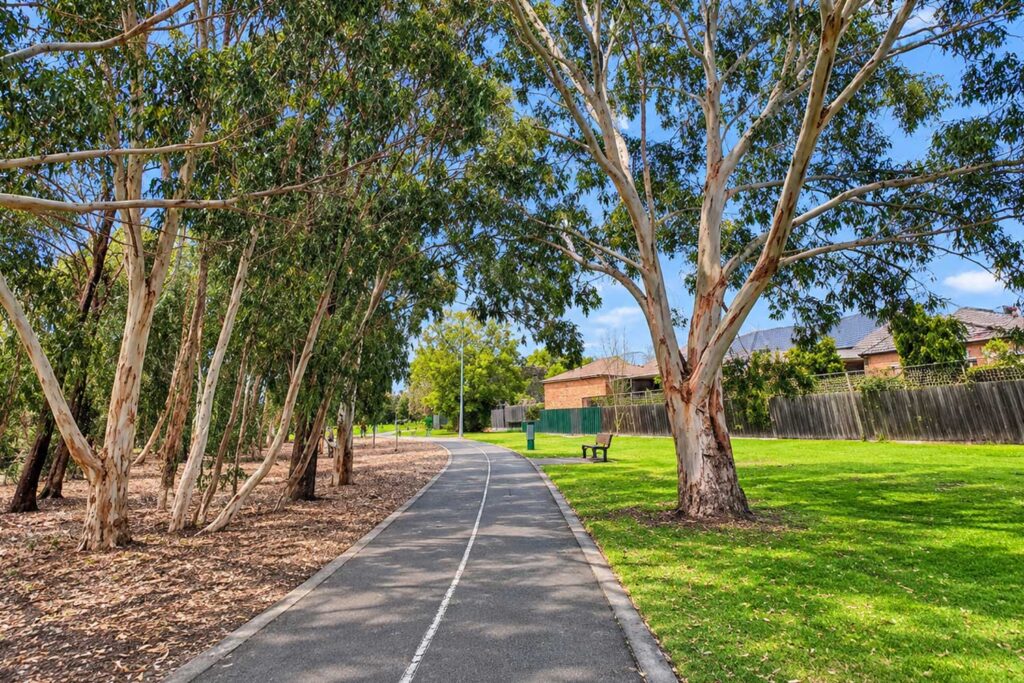
Just a few metres below the quiet residential streets of Canterbury, a shaded corridor of asphalt and native bushland traces the path of a nineteenth-century engineering ambition. Passing through a deep earthen cutting between Mont Albert Road and Canterbury Road, this sheltered stretch of the Outer Circle Railway Anniversary Trail offers one of Melbourne’s most distinctive settings for everyday movement, dog walking, and unhurried reflection.
From Nineteenth-Century Railway to Linear Sanctuary
To walk or ride through the Canterbury cutting today is to travel along the footprint of Victoria’s short-lived Outer Circle railway line. Constructed during the land boom of the late 1880s and opened in stages in 1890 and 1891, the line was engineered under the supervision of a young John Monash before his celebrated military and civic career. Intended to connect Melbourne’s outer eastern suburbs without routing passengers through the central city, the railway struggled commercially and closed across its northern sections by April 1893.
Rather than disappearing beneath suburban subdivision, the abandoned rail corridor was preserved and eventually reimagined as a continuous linear park. Named in recognition of Victoria’s 150th anniversary in 1985 and developed through the 1990s by the City of Boroondara and Parks Victoria, the sealed shared path now links the Yarra River Trail in the north to the Gardiners Creek Trail in the south. Along the way, interpretive heritage plaques mark the sites of vanished nineteenth-century stops, including the former Roystead and Shenley stations within Canterbury.
A Sheltered Microclimate for Everyday Movement
What distinguishes the Canterbury section of the Anniversary Trail from conventional suburban footpaths is its physical separation from traffic. Because the nineteenth-century engineers excavated a deep cutting to maintain an even gradient for steam locomotives, modern pedestrians and cyclists move through a sunken green valley buffered from road noise.
Dense plantings of eucalypts, wattles, and understorey shrubs line the embankments, creating a cool, dappled canopy during warmer months and blocking brisk southerly winds in winter. For local residents, that sheltered microclimate removes many of the everyday excuses that derail outdoor exercise. Morning runners, pram-pushing parents, and commuter cyclists share the sealed surface alongside older residents enjoying a flat, predictable grade away from busy intersections.
Thoughtful Design for All Hours and Companions
Recent infrastructure upgrades have further integrated the corridor into daily neighbourhood routines. Between Mont Albert Road and Canterbury Road, the City of Boroondara installed energy-efficient solar lighting programmed to glow crisp white during early morning and evening peak hours before shifting to a softer, dimmed amber overnight. This subtle lighting adjustment extends safe access for dawn walkers and evening commuters while minimising disruption to local nocturnal wildlife.
The trail also plays a central role in the daily rituals of Canterbury’s dog owners. Drinking fountains fitted with low-level dog bowls are spaced along the route, and while dogs remain on lead along the shared pathway to ensure smooth passage alongside cyclists, the corridor connects directly to nearby reserves and pocket parks.
Connecting Recreation with Village Life
Beyond its physical health benefits, the Anniversary Trail functions as an active transport spine linking Canterbury’s residential pockets with everyday village conveniences. Walking south from the cutting toward Canterbury Road brings trail users within a short stroll of Maling Road’s heritage shopfronts, where morning walks routinely conclude over takeaway coffee or freshly baked pastries at long-standing local cafés.
Further south past East Camberwell, the trail runs parallel to the operational Alamein railway line, allowing residents to combine recreational walking or cycling with effortless public transport connections. The gentle, traffic-free corridor also provides a practical route for local students cycling to nearby primary and secondary schools across the precinct.
In a suburb prized for its established gardens and architectural heritage, the Anniversary Trail demonstrates how historical infrastructure can quietly elevate modern wellbeing. Beneath the canopy of the old railway cutting, daily exercise feels less like a scheduled chore and more like a restorative pause woven naturally into the rhythm of neighbourhood life.