
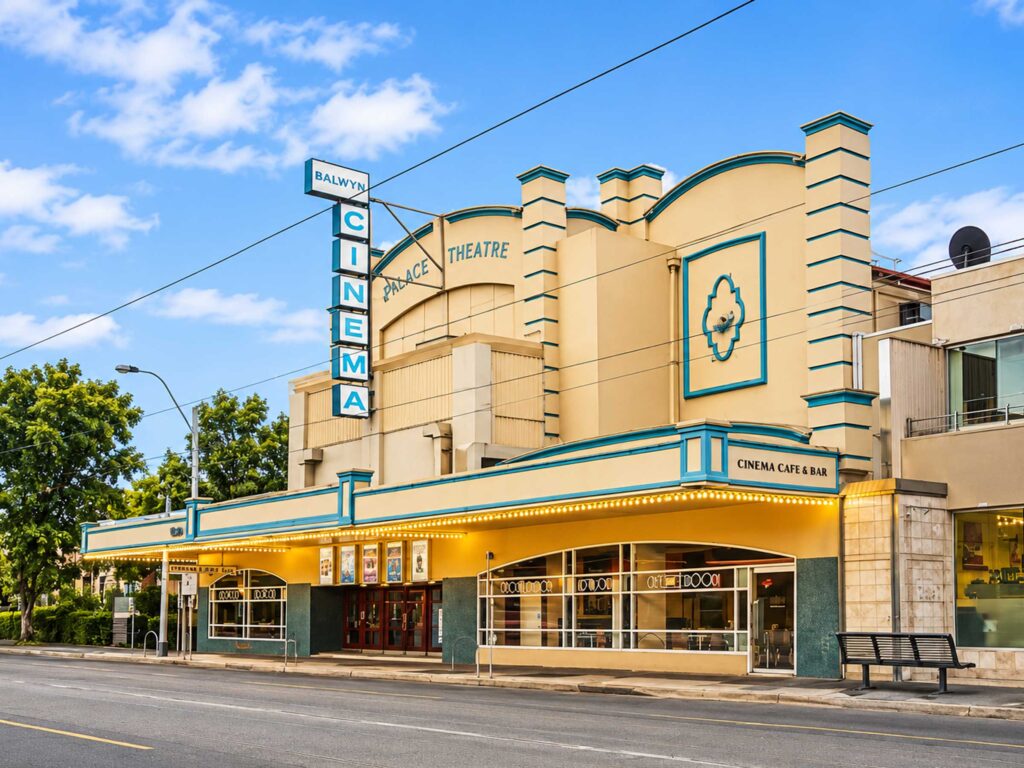
Along the busy commercial corridor of Whitehorse Road in Balwyn, roughly ten kilometres east of Melbourne’s central business district, the Art Deco facade of Palace Balwyn Cinema stands as one of the suburb’s most recognisable commercial landmarks. Operating at 231 Whitehorse Road since 1930, the site demonstrates how an independent Australian entertainment enterprise can preserve a heritage building while scaling its commercial footprint to meet the expectations of a modern suburban market.
At a time when suburban shopping strips across Melbourne face intense competition from regional shopping centres and digital home entertainment, the multi-stage evolution of Palace Balwyn Cinema offers a practical example of adaptive business strategy. Under the stewardship of family-owned Australian exhibitor Palace Cinemas, the venue has grown from a single-screen picture theatre into an 11-screen complex that anchors daytime and evening trade across the Balwyn Shopping Centre precinct.
A Suburban Landmark Built Along the Tram Line
The commercial history of 231 Whitehorse Road is closely tied to the expansion of Melbourne’s eastern tram network. Following the extension of electric tram services along Whitehorse Road through Balwyn in 1916, retail and civic activity steadily consolidated around the intersection of Whitehorse Road and Balwyn Road. When the original single-screen picture theatre opened on the site in 1930, it was designed on an ambitious scale for what was then a quiet outer-eastern suburb, featuring a distinctive inter-war Art Deco exterior and decorative foyer tiling.
Over subsequent decades, suburban cinemas across Australia confronted successive waves of disruption, from the arrival of broadcast television in the 1950s to the rise of multiplex chains in the late twentieth century. Many single-screen neighbourhood theatres closed or were demolished for commercial redevelopment. The Whitehorse Road building survived through continuous operation and architectural durability, later earning heritage recognition under the Boroondara Planning Scheme for its historical and aesthetic contribution to the Balwyn streetscape.
Acquisition and Expansion Under Palace Cinemas
A decisive turning point arrived in 1994, when the venue was acquired by Palace Cinemas, an independent Australian cinema company founded in Melbourne in 1965 by Antonio Zeccola and still managed by the Zeccola family under Chief Executive Officer Benjamin Zeccola. Rather than treating the Balwyn site as a static heritage asset, the company embarked on a long-term program of staged capital investment designed to balance architectural conservation with multi-screen commercial viability.
In February 1994, the original single auditorium was converted into a three-screen cinema, allowing the business to screen multiple titles simultaneously and broaden its audience base. Eleven years later, in 2005, a major flood prompted a comprehensive foyer restoration that uncovered and preserved the building’s original 1930s tiled floor, while auditorium capacity expanded to five screens. For more than a decade, the Whitehorse Road property also served as the national corporate head office of Palace Cinemas before the company relocated its administrative headquarters to South Yarra in 2016 to support its growing national circuit.
Scaling to an 11-Screen Precinct Complex
Following the relocation of its head office, Palace Cinemas executed its most substantial physical expansion at the Balwyn site. Four additional auditoriums opened in December 2016, followed by two more in March 2017, bringing the complex to 11 screens in total. The redevelopment paired contemporary projection and acoustic infrastructure, including boutique Deluxe auditoriums and a licensed wine and espresso bar, with the retention of the historic Whitehorse Road street frontage.
Differentiated Programming and Economic Spillover
A core element of the business model at Palace Balwyn Cinema lies in its curated programming. While major suburban multiplexes rely heavily on mainstream studio blockbusters, the Balwyn venue divides its 11 screens across international cinema, Australian independent releases, curated retrospectives, and national cultural showcases such as the British Film Festival and the Japanese Film Festival. This programming breadth is supported by dedicated daytime sessions for older residents alongside private venue hire for corporate presentations, school groups, and community organisations.
That customer mix aligns closely with the surrounding demographic profile documented by the City of Boroondara for the Balwyn Shopping Centre catchment. Within a 1.5-kilometre radius of the Whitehorse Road and Balwyn Road intersection, families with children represent 36 per cent of households, while residents aged 60 and over account for 28 per cent of the local population, and 41 per cent of residents were born overseas. By programming across morning, afternoon, and late-evening sessions seven days a week, the cinema serves multiple generations within a single commercial footprint.
For neighbouring traders along Whitehorse Road, the economic value of a high-capacity cinema lies in its ability to generate consistent foot traffic outside standard nine-to-five retail hours. Patrons attending evening screenings or weekend festival sessions regularly dine at nearby restaurants, visit local bakeries and cafes, and use surrounding retail services. Nearly a century after its doors first opened, Palace Balwyn Cinema illustrates how sustained reinvestment in heritage infrastructure can keep a suburban high street commercially active well into the evening.